
My pole barn has no electricity. The electrician is coming eventually, but “eventually” doesn’t help when the days get short in October and I’ve got projects stacked up.
So I’ve now run two different battery power stations in two completely different ways — a small one bolted into my mobile workbench, and a big one lighting the entire barn. Three days of hard use on one, a full lighting install on the other.
The question nobody actually answers in these reviews is the only one that matters: which size do you need? Not which brand. Which size. Because buying too small means you’re charging it every night, and buying too big means you spent hundreds of dollars carrying around capacity you never touch.
Here’s what I learned running both.
Test One: I Bolted a C1000 Into My Workbench and Tried to Kill It

The first one I tested was the Anker SOLIX C1000. 1,056 watt hours, 1,800 watts of output. It’s roughly the size of a car battery with a set of decent handles on it — heavy, but a one-person carry.
I didn’t want it sitting on the floor getting knocked around, so I built it into my mobile workbench. That meant taking a 2x4 on the back side down to a 2x2 — about two inches off, leaving an inch and a half, which is still plenty of support for the tabletop. Ten inches of clearance and it slid right in. Lid goes back on and nobody knows it’s in there.
Then I took the whole bench out to a paving project and spent three days trying to run it flat.
What it actually powered
A chop saw. Two drills. Tool battery chargers running most of the day. A radio. My laptop, which is on for basically every project I film. A GoPro battery charger with three batteries in it. A Huepar rotary laser. A shop vac at the end for cleanup. And finally an air compressor, which is the one that finished it off.
The three-day drain, exactly as it happened

| When | Battery | What was running |
|---|---|---|
| Day 1, morning | 100% | Tool batteries charging, radio, laptop |
| Day 1, +2 hrs | 89% | Down 11% charging tool batteries |
| Day 1, end | 84% | Chop saw cutting 4x4s |
| Overnight | 83% | Left the radio, a charger and the laser on by accident |
| Day 2, end | 62% | 2x6 and 2x8 cutting all day |
| Day 3, midday | 45% | App estimated 15 hours remaining |
| Day 3 | 34% | 26 more cuts, 45° and 90° angles |
| Day 3 | 24% | Shop vac cleanup |
| Day 3, end | 0% | Air compressor finished it |
Three days. An entire project. One charge.
Two things worth pulling out of that table. First, leaving gear on overnight cost me one percent — the idle draw on these is genuinely low now, which was not true of battery stations a few years ago. Second, the compressor is what killed it. Everything else sipped. High-draw motors are where capacity disappears, and that’s the honest limit of a unit this size.
The recharge claim, checked
Anker says 58 minutes from zero to full. I timed it because I didn’t believe it.
47 minutes flat. Faster than advertised, which almost never happens. I can’t charge my phone that quickly.
1,056Wh, 1,800W. The one I ran flat over three days of real cutting.
Test Two: Lighting an Entire Barn With a C2000

Different problem. I didn’t need portable — I needed enough capacity to light a 28x32 building through the dark months until the electrician shows up.
That’s the Anker SOLIX C2000 Gen 2. 2,048 watt hours, 2,400 watts continuous, 4,000 watts peak. Double the off-grid capacity of the C1000.
The spec that actually matters for this job isn’t the big number though — it’s the small one. Nine watts on standby. When you’re leaving a unit plugged into a building for weeks at a time, idle draw is what quietly eats your capacity. Anker claims that’s the lowest in the industry. What I can tell you is that mine ran my garage door opener for about seven days and was still sitting at 62%.
115,000 lumens on three circuits
I ran three separate lighting circuits — upper bay, lower bay, and under the loft — plus a plug for charging batteries. The lights are Hyperlite, in four different types: 150-watt jumbo units with three colour settings, 100-watt halos, 100-watt canopy lights, and some 65-watt units.
All in, that’s about 115,000 lumens, completely off grid.

| Light bank | Draw | Output | Runtime |
|---|---|---|---|
| Bank one | 200W | ~29,000 lm | Over 9 hours |
| Bank two | 300W | ~43,000 lm | Just over 6 hours |
| Canopy lights | 330W | ~43,000 lm | Just under 6 hours |
Add the expansion battery and those runtimes roughly double.
For reference on surge: opening the garage door pulled about 1,064 watts and peaked around 1,149. Comfortably inside what this unit does without thinking about it.
2,048Wh, 2,400W continuous, 4,000W peak. The one lighting my barn.
So Which One Do You Actually Need?
| C1000 | C2000 Gen 2 | |
|---|---|---|
| Capacity | 1,056Wh | 2,048Wh |
| Continuous output | 1,800W | 2,400W |
| Peak | Handled a ~2,500W saw surge | 4,000W |
| Best for | One person, hand tools, a day or three of cutting | Lighting a building, or tools plus lights together |
| Portability | One-person carry, fits in a workbench | Stays where you put it |
Buy the C1000 if you’re one person with hand tools working away from an outlet — a job site, a deck build, the far end of the property. Three days of intermittent cutting on one charge is genuinely useful.
Buy the C2000 if you’re powering a space rather than a project. Lights that stay on. Something plugged in for weeks. Anything with a compressor or a bigger motor in the mix.
What I’d Tell You Before You Spend the Money
A few honest things.
Three days doesn’t mean three days. My three days were intermittent tool use with long gaps — measuring, laying out, filming. If you’re cutting continuously you will not get that. Read my numbers as a realistic work rhythm, not a runtime guarantee.
Motors are the enemy. The compressor took the C1000 from 9% to dead. Saws and drills barely registered by comparison. If your work involves compressors, welders, or anything with a big startup draw, size up past what the runtime charts suggest.
Neither one replaces a wired circuit. I’m still having an electrician run a line to the barn. This is a bridge — a good one, one that let me keep working through a season I’d otherwise have lost — but it’s a bridge.
And I’m not keeping the C1000 in the workbench permanently. Most of my projects happen right by the garage where there’s already power. It earns its keep around the house, tailgating, and during outages. Building it into the bench was a great experiment; it just isn’t where it lives.
Questions I Get Asked
Will one of these run a table saw?
My chop saw spiked to around 2,500 watts on startup and settled near 700. A table saw behaves similarly. The C1000 handled it; the C2000 has considerably more headroom. Check your tool’s startup surge, not its running watts — that’s the number that trips people up.
Can you add solar?
Both units accept solar panels and both are expandable with additional battery packs. I ran mine on wall charging for these tests, so I can’t give you measured solar numbers yet.
How long do they hold a charge sitting idle?
The C2000 draws 9 watts on standby. Mine ran a garage door opener for roughly a week and was still at 62%, which tells you idle drain isn’t what it used to be on these things.
Is this cheaper than running electrical to a barn?
Up front, yes, by a wide margin. Long term, no — a real circuit is a real circuit. I’m doing both: battery now, wiring when the electrician gets here.
The 28x32 pole barn in this post is one I built myself. The complete plan set is 30 printable pages, 75+ numbered steps, bookshelf girts and the full material list.
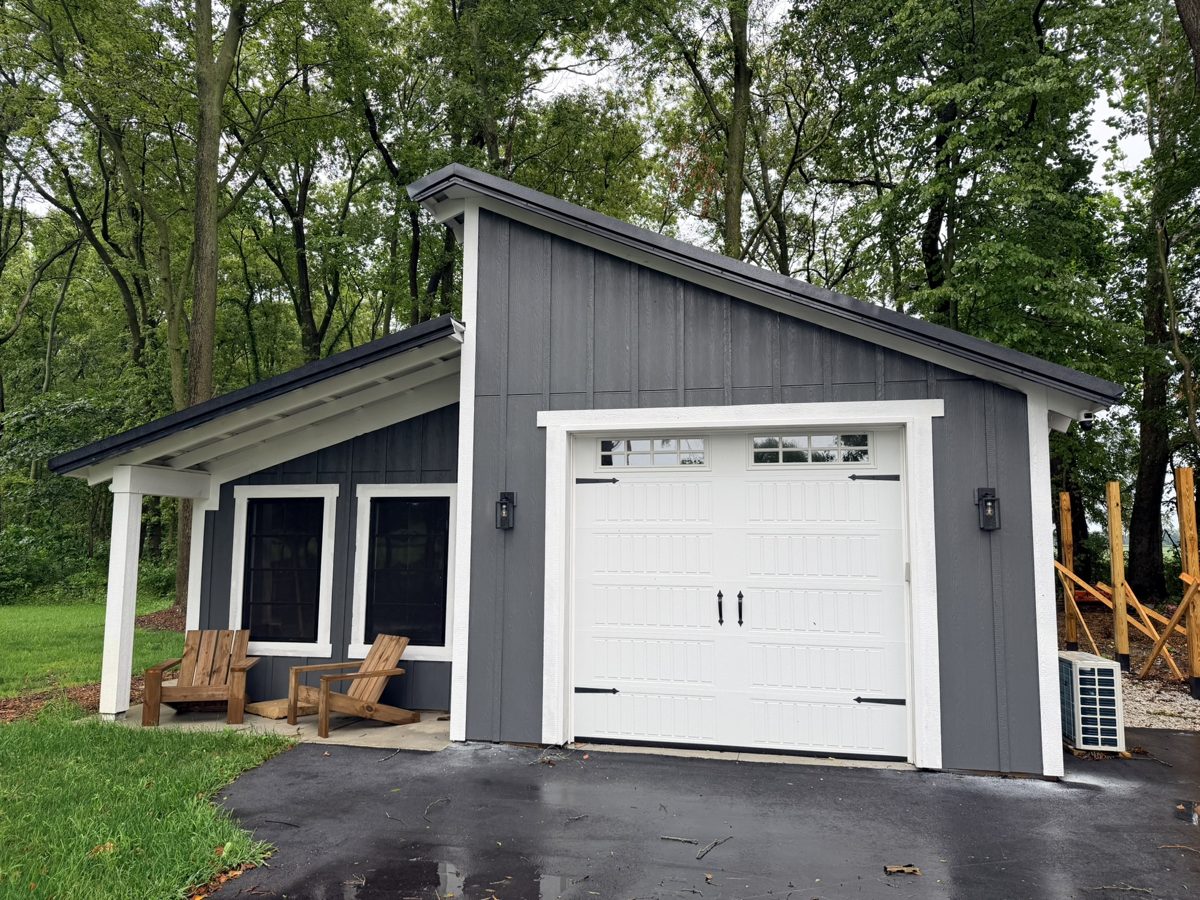
28x32 Pole Barn Plans
The complete plan set from my real build. Two-bay layout, bookshelf girts, optional front and rear porches.